FITUR 2026 puts the hotel sector's biggest challenges back on the table: digitalisation, guest experience, operational efficiency, and, increasingly, cybersecurity.
The adoption of cloud-based PMS platforms, channel managers, contactless check-in, digital payments and process automation has turned hotels into tech businesses operating 24/7. In this context, security has stopped being a purely technical topic and become a key factor for business continuity.
FITUR will focus on innovation, but the question many executives are starting to ask is clear:
Are our systems genuinely prepared to handle a cybersecurity incident at peak season?
Cyberattacks on hotels are not a future hypothesis, they are happening right now. The properties that approach cybersecurity strategically, before an incident occurs, are the ones that best protect their reputation, their revenue and their guests' trust.
FITUR 2026 is an opportunity to reflect on this:
Digital transformation without cybersecurity is a risk the sector can no longer afford.
Digitalisation has completely transformed hotel operations: online bookings, digital check-in, PMS systems, guest WiFi, electronic payments, integrations with multiple platforms...
All of this improves the guest experience, but it also significantly expands the attack surface.
In recent years, the hotel sector has become a priority target for cybercriminals, not so much because of its size, but because of the value of the data it handles and its need to operate around the clock.
Here are the main cybersecurity risks affecting the hotel sector in Spain today.
1. Personal and financial data theft
Hotels handle highly sensitive information:
- Personal data (ID documents, passports, addresses)
- Payment data
- Stay history and guest preferences
A security breach can lead to:
- GDPR penalties
- Loss of customer trust
- Reputational damage that is difficult to recover from
The impact is not just technical, it is legal and commercial.
2. Phishing and staff identity impersonation
Reception, reservations and administration receive daily emails from:
- Booking platforms
- Suppliers
- Clients and travel agencies
This makes staff one of the main attack vectors:
- Fraudulent emails
- Phishing
- Identity impersonation
A single click can compromise critical hotel systems.
3. Ransomware: the attack that can shut a hotel down
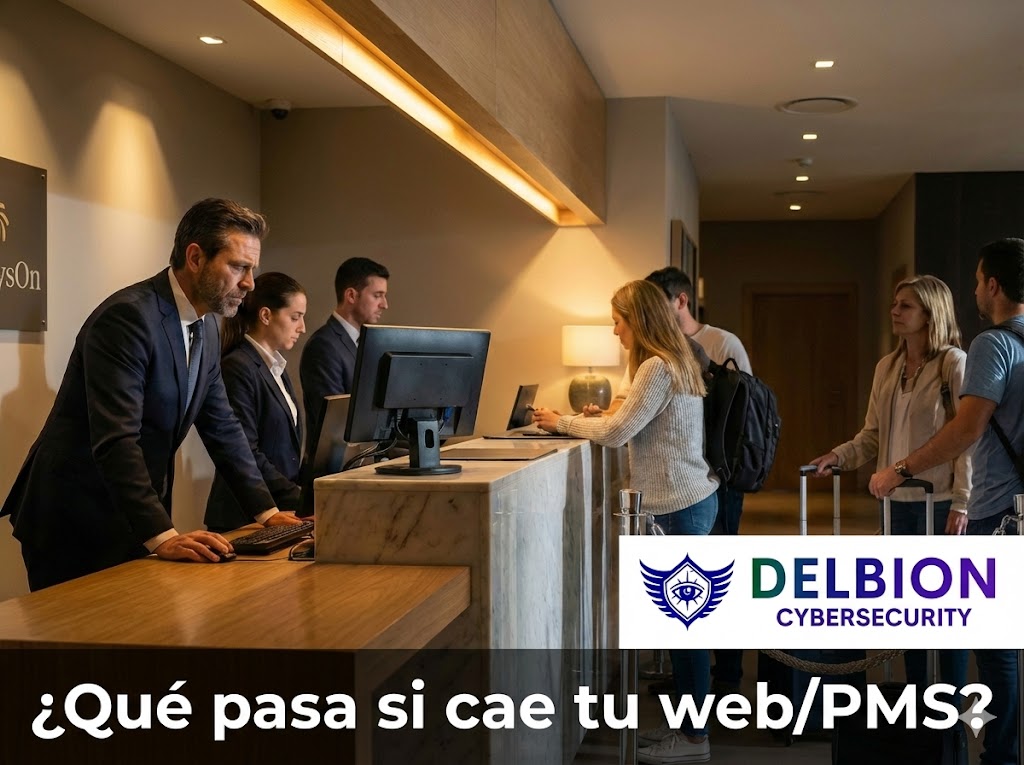
- Operations cannot stop
- The impact on guests and revenue is immediate
- The pressure to pay the ransom is very high
There are real cases of hotels left:
- Without access to their PMS
- Unable to manage reservations
- Without control over electronic key systems
Every hour of downtime means financial and reputational losses.
4. Secure WiFi networks
Many breaches start with:
- Poorly configured WiFi networks
- Lack of segmentation between the guest network and the internal network
- Weak or shared passwords
An attacker does not need physical access to the hotel, they can launch the attack from a room or even from outside the building.
5. Vendors and external platforms as weak links
Channel managers, booking engines, POS systems, IT maintenance providers...
If a vendor suffers an incident:
- The hotel can also be affected
- Control no longer rests solely with the property itself
A hotel's security is only as strong as the weakest link in its chain.
How can hotels reduce these risks?
Cybersecurity is not just about installing an antivirus, it is about managing risk strategically:
- Staff awareness and training
- Protection and monitoring of critical systems
- Real, verified backups
- Access controls and network segmentation
- Risk assessment and regulatory compliance
Many hotels that work with the public sector or handle sensitive data need certifications such as ISO 27001 or the National Security Framework (ENS). These certifications do not just protect, they demonstrate to clients and partners that security is a priority.
Today, cybersecurity is no longer an IT expense: it is an investment in business continuity and customer trust.
Final thoughts
Hotels that get ahead of the risks:
- Protect their reputation
- Comply with regulations
- Build trust with their guests
- Avoid incidents that cost far more than preventing them
The question is no longer whether a hotel will be attacked, but whether it is prepared when it happens.
Free Audit
Is your hotel prepared for a cyberattack?
Request a free cybersecurity audit. In 60 minutes we analyse your property's attack surface, identify critical vulnerabilities and deliver a prioritised action plan.
Request Free Audit →Your team needs secure AI training
The EU AI Act requires AI literacy for all staff from August 2026. Our courses cover compliance, AI agents and governance. FUNDAE can subsidise 100% of the cost.